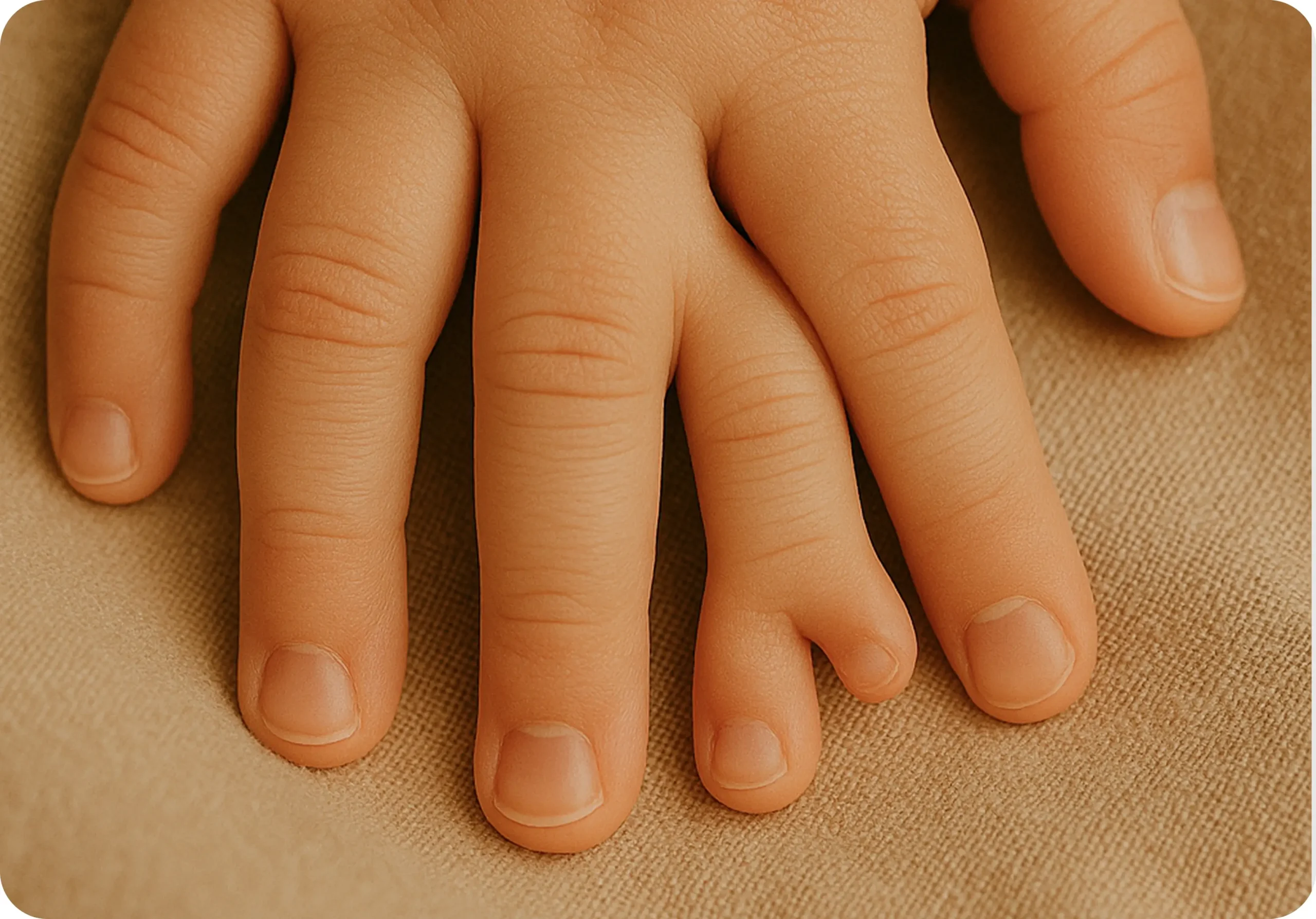
Finger deformities or the presence of extra fingers are congenital conditions that often cause concern for many parents when noticed at birth. Although they may seem rare to some, they are actually among the most common limb deformities. Their severity varies from simple cases that can be treated easily to more complex conditions that require specialized medical care.
What distinguishes these conditions is that early detection opens the door to effective solutions that allow normal development of the hand or foot without affecting movement or appearance. With modern medical and surgical advances, most of these deformities are now treatable with excellent outcomes. In this article, we discuss the causes of the condition, its main types, and how it is managed medically and surgically.
What Is the Condition of Extra Fingers?
Finger deformities or extra fingers are congenital conditions in which a child is born with an additional finger on the hand or foot due to an abnormality in limb formation during fetal development. The extra finger may be small and soft, attached only by skin, or larger and fully formed with bones and joints, making it resemble a normal finger. This condition is one of the most common limb deformities, is usually detected immediately after birth, and can often be treated easily, especially with early intervention.
Causes of Extra Fingers
The presence of extra fingers can result from several causes, ranging from simple developmental variations to genetic or hereditary factors. Although the exact cause is not always clear, most cases are explained by a minor disruption during finger formation in early pregnancy. Causes include:
Genetic Factors
Genetics is one of the most common causes, as the condition may be inherited from one of the parents or other family members, particularly in cases involving extra fingers on the hands.
Disturbances in Limb Development During Pregnancy
These deformities may result from a minor error during finger development in the early weeks of pregnancy, leading to excessive division of finger tissues.
Certain Genetic Syndromes
Extra fingers may appear as part of congenital syndromes such as Ellis–van Creveld syndrome or Down syndrome, though this does not apply to all cases.
Rare Environmental Factors
In limited cases, factors such as reduced blood supply to the fetus or the use of certain medications during pregnancy may play a role, but these are not considered primary causes.
Types of Finger Deformities
- Polydactyly: The presence of an extra finger on the hand or foot. The extra finger may be small and skin-attached only, or fully formed with bones and joints.
- Syndactyly: Fusion of two or more fingers, either by skin alone or involving the bones. This is one of the most common congenital hand deformities.
- Brachydactyly: A condition in which a child is born with unusually short fingers due to shortened bones, which may affect hand appearance and function in some types.
- Clinodactyly: Deviation or curvature of a finger inward or outward, most commonly the little finger. It may be mild or require treatment.
- Camptodactyly: A permanent flexion deformity of a finger joint that prevents full extension, often appearing during childhood.
- Hypoplasia: Underdevelopment of a finger or part of it, such as missing bone or tendon, which can affect strength and movement.
- Torsional Deformities: Twisting of a finger around its axis to varying degrees, which may cause difficulty with grip or hand function.
Treatment of Hand Deformities in Children
Treatment depends on the type and severity of the deformity, but the primary goal is usually to improve hand function and appearance to ensure normal development. The first step is accurate diagnosis through clinical examination and imaging studies, such as X-rays, to identify the affected bones and tendons.
In simple cases, such as small extra fingers attached only by skin, removal can be performed easily through a quick and simple procedure. More complex deformities, such as syndactyly or fully formed extra fingers, require precise reconstructive surgery to reshape the fingers and separate tissues to restore normal movement. In some cases, physical therapy is recommended after surgery to improve finger strength and flexibility.
When Do Extra Fingers Require Surgical Intervention?
Surgical intervention is recommended when extra fingers affect the shape of the hand or foot, interfere with normal movement, or are connected to bones and tendons that make simple removal impossible. Surgery is also advised if the extra finger is large, fused with another finger, or causes difficulty with wearing shoes or grasping objects.
In most cases, surgery is ideally performed between 6 and 12 months of age to achieve optimal functional and cosmetic outcomes, with faster recovery and long-term benefits.
Cosmetic Surgery for the Treatment of Extra Fingers
Cosmetic and reconstructive surgery is the optimal solution when the extra finger is fully formed or connected to bones and tendons. The goal of surgery is to remove the extra finger, reconstruct surrounding tissues, and improve the appearance of the hand or foot while preserving normal movement.
Treatment begins with a thorough evaluation, including imaging studies, to determine the type of attachment and complexity. The surgeon then develops a precise surgical plan that considers both hand function and appearance. The procedure is typically performed under general anesthesia between 6 and 12 months of age. The surgeon carefully removes the extra finger and reconstructs ligaments, tendons, and bones as needed to achieve the best functional and aesthetic result.
After surgery, the child requires a short period of care and follow-up, and physical therapy may be recommended to enhance finger mobility. With this approach, most children achieve a normally shaped and fully functional hand or foot, with lasting and satisfying results for parents.
Frequently Asked Questions About Finger Deformities or Extra Fingers
Is having extra fingers considered a deformity?
Yes, having extra fingers is considered a congenital deformity, as the child is born with an additional finger on the hand or foot. Although it is usually benign and not life-threatening, it may affect function or appearance, so early evaluation is recommended to determine the appropriate treatment.
What does the presence of extra fingers indicate?
The presence of extra fingers indicates that the child was born with one or more additional fingers beyond the normal number on the hand or foot. This common congenital condition may involve a small, skin-attached finger or a fully formed finger with bones and joints, and it may sometimes affect movement or appearance.
What causes finger deformities?
Finger deformities are most often congenital or genetic, resulting from abnormalities in finger development during pregnancy. Certain genetic syndromes or environmental factors may play a secondary role, but the majority of cases are due to disruptions in tissue and bone development during fetal hand formation.
Conclusion
Finger deformities or the presence of extra fingers are common congenital conditions that can be effectively managed when detected early. Appropriate medical care—whether conservative management or reconstructive surgery—ensures normal hand or foot function and an acceptable cosmetic appearance.
If you notice extra fingers or finger deformities in yourself or your child, do not hesitate to consult a specialist for proper evaluation and an individualized treatment plan. Early intervention offers the best long-term outcomes.